
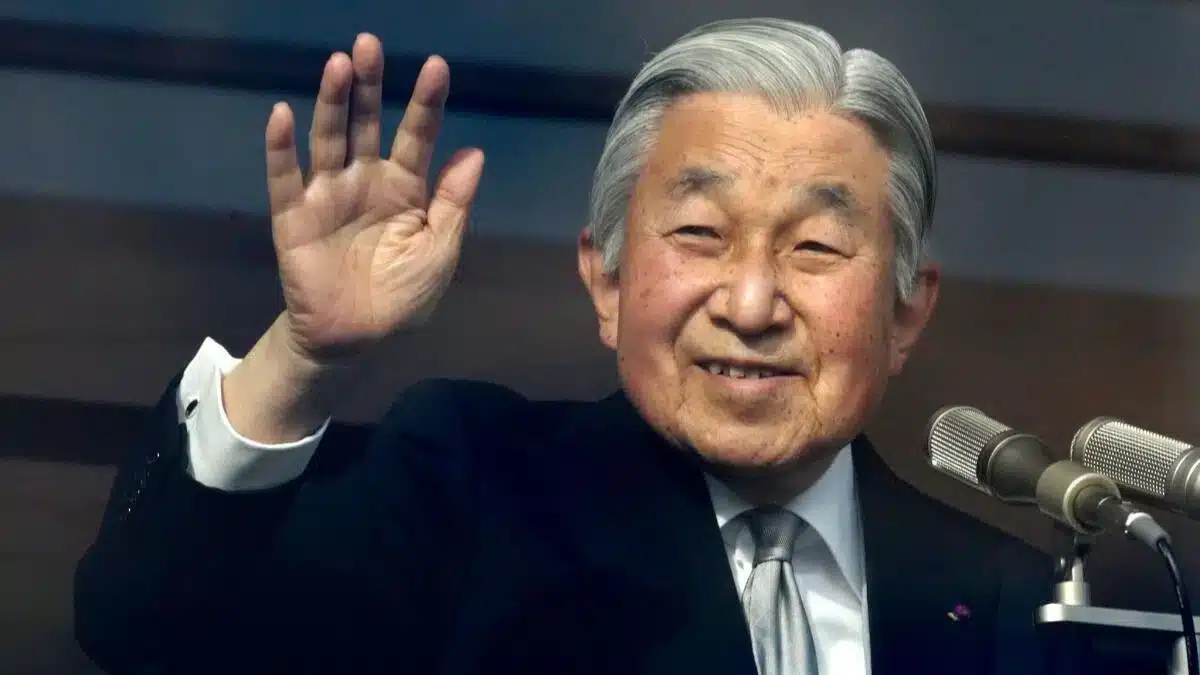


The Imperial Household Agency is weighing a scaled-down rite inside the palace, with attendance cut to about 2,500, in line with a wish Akihito made public in 2013.
Japan’s Imperial Household Agency is planning a smaller funeral for Emperor Emeritus Akihito than the one held for his father. The change follows the emperor emeritus’s own wish to spare the public disruption.
Akihito is 92 and in good general health. The agency stressed that the planning is not a response to any decline in his condition.
Under the draft plan, the Sojoden no Gi rite would be held in the Matsu no Ma, or Pine Room, at the Imperial Palace. That replaces the large temporary pavilion built in a public park last time.
Attendance could fall to about 2,500 people, a quarter of the number at the funeral for Emperor Showa. The agency is also considering splitting proceedings that once ran in a single day across two days.
The wishes behind the plan are not new. The agency published them on November 14, 2013, while Akihito was still on the throne.
The document said he did not want his tomb or his funeral to place a heavy burden on the public. Arrangements should disrupt ordinary life as little as possible.
He also raised environmental concerns, from the felling of trees for temporary halls to the long closure of public spaces. He worried too about the safety of mourners in extreme heat, cold or heavy rain.
The Pine Room was proposed partly for those reasons. It sits indoors and is easier to secure, and it requires no large public site.
Smaller than the funeral for Emperor Showa
When Emperor Showa died in 1989, the Sojoden no Gi and the state Taiso no Rei were held at Shinjuku Gyoen park in Tokyo. About 10,000 Japanese and foreign representatives attended.
Police deployed roughly 32,000 officers, including 6,000 support staff drawn from across the country. It was the largest single-day police operation in Japan at the time.
That site also required temporary halls and a long closure to the public. The new plan uses space the palace already has and cuts attendance sharply.
Cremation instead of burial
Akihito and Empress Emerita Michiko have also asked to be cremated rather than buried, ending an imperial practice of about 350 years.
The agency noted that the imperial family has used both burial and cremation in the past. Cremation is now standard across Japanese society, so the change does not break with court history.
Their tombs will be built separately but side by side in the same grounds. Both will be smaller than those of the previous emperor and empress.
Akihito turns 93 in December. He abdicated on April 30, 2019 and ended his public duties. He now lives quietly with Michiko at the Sento Palace in Tokyo’s Akasaka district.
The scaled-down plan has been reported to Emperor Naruhito. The details are still under review and nothing has been finalised.
Related news
- Mall blast, blackouts and evacuations mark Japan’s Kyushu quake
- Japanese tourists eye Thailand as yen rebounds from 40-year low
- Japan’s automakers told their base in Thailand is safe
Sources
The story Japan plans smaller funeral for Emperor Emeritus Akihito as seen on Thaiger News.