
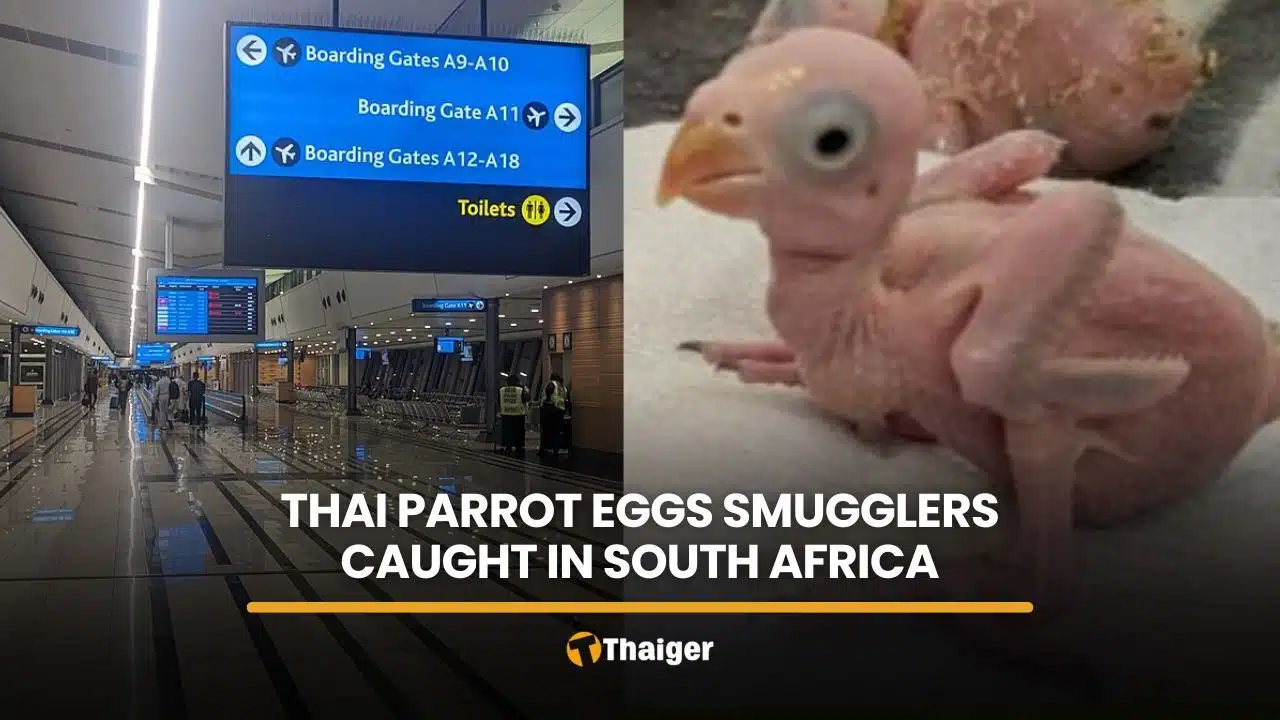


A 50 year old Thai national was arrested at OR Tambo International Airport in Johannesburg on August 20 after allegedly attempting to smuggle 50 bird eggs out of South Africa in a homemade incubator bag carried as hand luggage.
According to SAnews.gov.za, preliminary investigations indicate the eggs came from parrot species protected under the Convention on International Trade in Endangered Species of Wild Fauna and Flora (CITES).
The department said the operation was led by its Environmental Management Inspectorate, alongside SAPS Crime Intelligence and Border Police, with support from the SAPS Stock Theft and Endangered Species Unit.
Some of the recovered eggs have since hatched, and specialists are providing intensive care to give the chicks the best chance of surviving. The department also credited personnel at the South African National Biodiversity Institute with helping safeguard the animals.

The arrest followed a similar case on July 16, when a 23 year old Thai national was intercepted at the same airport while allegedly attempting to smuggle 418 parrot eggs in two homemade incubator bags. Investigations into both cases remain ongoing.
The department said the two arrests show how increasingly sophisticated international wildlife trafficking operations have become.
Minister of Forestry, Fisheries and the Environment David Maynier welcomed both arrests, saying complex criminal networks involved in wildlife trafficking could only be tackled through coordinated efforts to protect the country’s natural heritage.

Wildlife trafficking remains a major threat in South Africa, one of the world’s most biodiverse countries. AFP reported that criminal networks target species including rhinos, elephants, pangolins and reptiles for the global black market.
The department warned that taking parrot eggs from the wild and trafficking them can harm bird populations and the animals themselves. Smugglers often use makeshift incubators, while transportation conditions can reduce the eggs’ chances of survival and put embryos and newly hatched chicks at risk.
Exporting CITES-listed specimens requires permits from both the exporting and importing countries. Under South Africa’s National Environmental Management: Biodiversity Act, a person convicted of an offence can face up to 10 years in prison, a fine of up to 10 million rand (US$627,000), or both.
Related news
3 Thai men arrested in Ecuador with 12 rare Galápagos iguanas
Sri Lankan man caught smuggling snakes in underwear at Bangkok airport
27 animals seized, 2 arrested in Bangkok airport wildlife sting
The story South Africa intercepts Thai men with 468 parrot eggs in separate cases as seen on Thaiger News.