
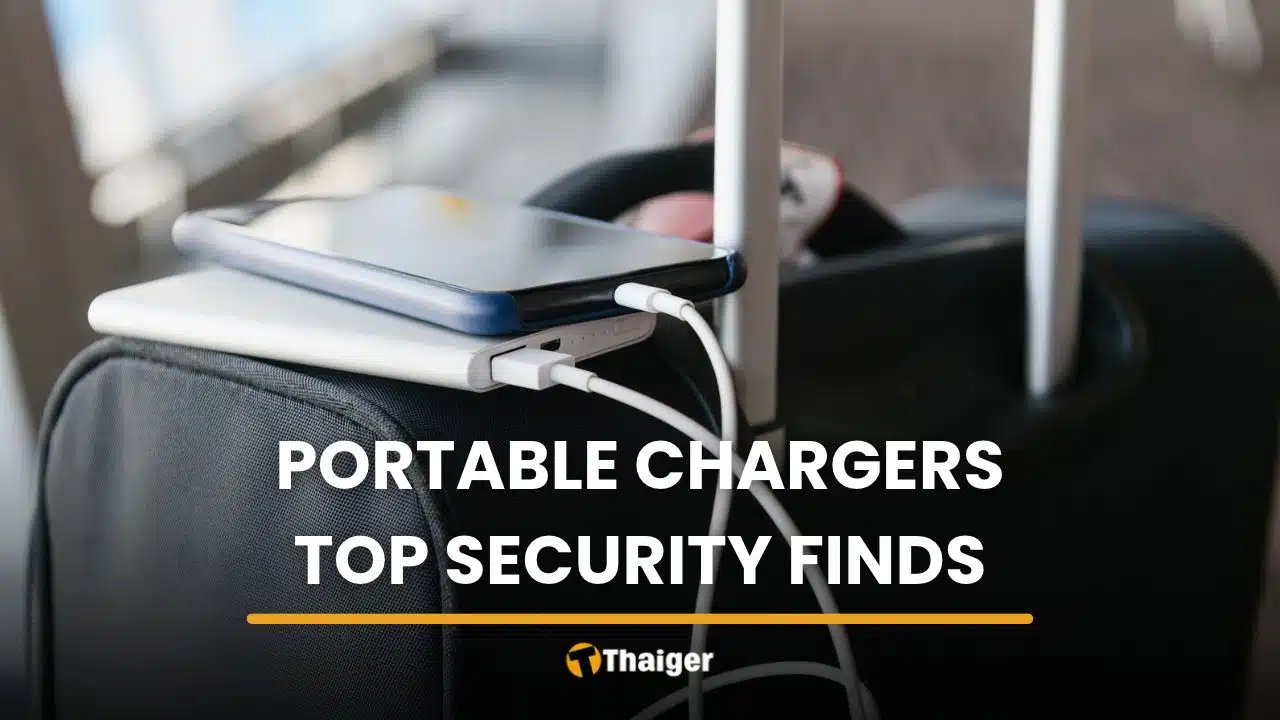


Power banks have emerged as the most common banned items found in checked baggage at Thai airports since new baggage inspection rules took effect on October 16, according to the Civil Aviation Authority of Thailand (CAAT).
The aviation regulator reported the findings yesterday, October 25, after reviewing the implementation of the new measures, which allow airport security personnel to open suspicious checked bags without passengers being present.
CAAT said it also detected battery-powered electronic devices during screening. Such equipment can pose fire and short-circuit risks if stored or transported incorrectly, particularly in an aircraft’s baggage hold.
Passengers are prohibited from packing power banks in checked baggage and must instead carry them in their hand luggage, subject to capacity and quantity restrictions.
Under CAAT’s separate power bank regulations introduced earlier this year, passengers may carry up to two power banks, with devices rated above 100 watt-hours requiring airline approval if they do not exceed 160 watt-hours. Using or charging power banks during flights is also prohibited.
The latest findings follow Thailand’s new baggage inspection rules, introduced on October 16. These permit authorised airport officers to inspect checked baggage without its owner present, but only when X-ray screening reveals reasonable grounds to suspect prohibited or dangerous items.

Officers must take flagged luggage to a designated inspection area, record the search and leave a Notice of Baggage Inspection inside the bag. CAAT stressed that the rules do not permit airport staff to open every passenger’s luggage routinely.
The regulator also reviewed four complaints circulating on social media about luggage being opened. It found that only one involved an inspection under the new Thai procedures, after officers detected a battery-powered device on a domestic flight.
In that case, the passenger’s bag did not have a TSA-compatible lock, and officers had to cut its zip to conduct the search. CAAT said an inspection notice was left inside.
CAAT advised travellers to check their airline’s baggage restrictions before flying, use suitable luggage locks and avoid placing valuables in checked bags.
Passengers were also encouraged to photograph the contents of their luggage before closing it and the outside of their bags at check-in. These photographs could help support enquiries if belongings are damaged, lost or delayed.
The regulator said the inspections were intended to protect aviation safety while maintaining procedures that could be reviewed if passengers raised concerns.
The story Power banks top banned items in Thailand’s checked baggage as seen on Thaiger News.