
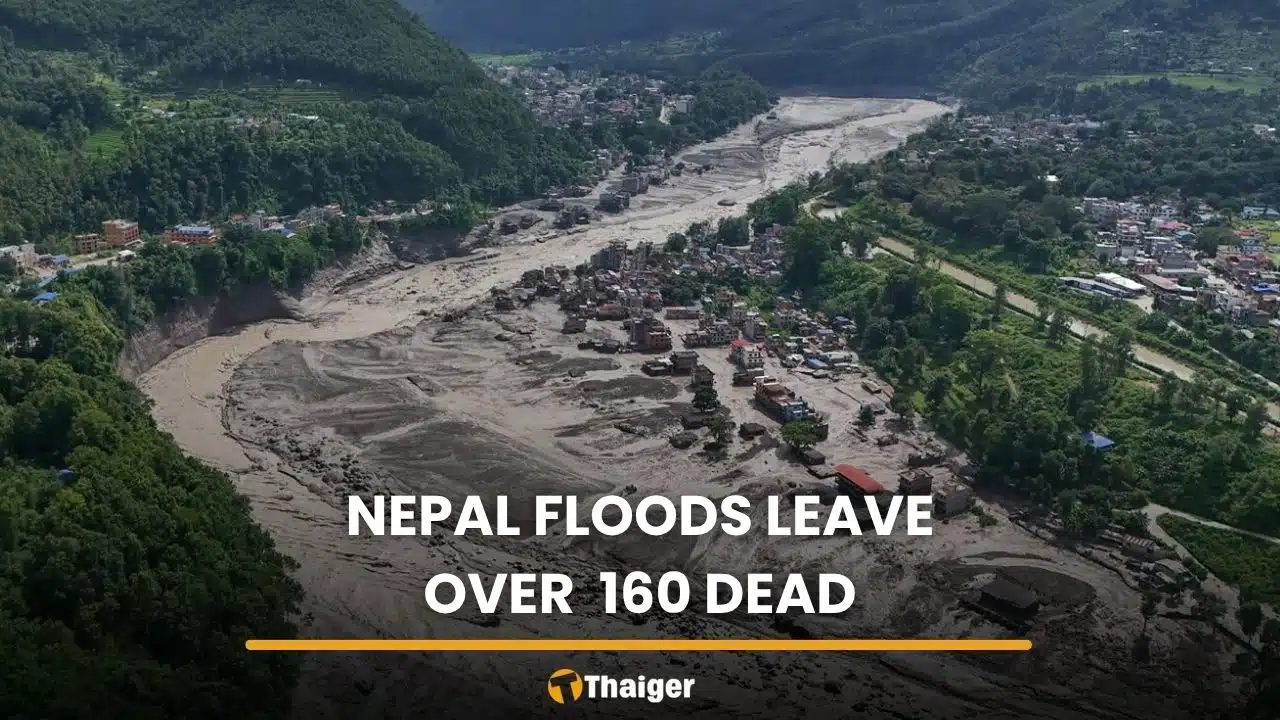


At least 160 people have died in flash floods along Nepal’s border with Tibet, Nepal Police said in an announcement on X early this morning, August 27. Hundreds more are missing.
Police have published details of 49 people admitted to hospital, most of them from Nuwakot and Rasuwa districts. The toll is expected to rise. All figures in this story are as of Thursday morning, Nepal time.
The Nepal Tourism Board said 403 people were unaccounted for, including 341 foreign nationals from 26 countries. Board Spokesperson Sunil Sharma said 133 of the missing were Indian pilgrims heading to Mount Kailash in Tibet. Another 47 were American and 33 British.
South Korea said some of its citizens working on a hydropower plant were among the missing. Malaysia said it had lost contact with 11 of its nationals believed to be in Rasuwa. At least 62 Nepalis trekking to Gosaikunda lake for the Janai Purnima festival are also missing.

The Prime Minister’s Office said 85 security personnel were unaccounted for. That included 44 from the Nepal Army, 28 from Nepal Police and 13 from the Armed Police Force. Sixty workers at the Langtang Khola hydropower project have been out of contact since Wednesday morning. Thirty-five of them were inside a tunnel when the floodwaters came.
The Bhotekoshi River flooded at about 9am yesterday, wiping out villages, roads and hydropower projects. The worst damage was along the Lhende Khola, a tributary near the Chinese border, about 65 kilometres north of Kathmandu.
Mud and debris then surged downstream through Rasuwa and Nuwakot districts and into the Trishuli and Narayani rivers. The flow buried multi-storey buildings, trucks and vans. Officials warned residents in several districts to stay away from the riverbanks.
Nepal’s foreign minister initially suspected an earthquake, but the US Geological Survey found no seismic event in the area. Scientists at the Kathmandu-based International Centre for Integrated Mountain Development have identified the cause.
An avalanche of ice and rock from a glacier on the Nepal side blocked the Lhende Khola, they say. The blockage then gave way, releasing the water at once.

Saswata Sanyal, a disaster risk specialist at the centre, noted the river had now flooded twice in 14 months. The same area was hit in August last year when a glacial lake in Tibet overflowed. That flood killed nine people and destroyed a bridge linking Nepal and China.
Prime Minister Balendra Shah said the country was in shock and that the state would take responsibility for rescue, treatment, food and shelter. He ordered the army, police and Armed Police Force to be mobilised. Government spokesperson Sasmit Pokharel said Nepal had asked both India and China for help.
According to the BBC, 1,697 army personnel were deployed, with a further 656 on standby. Six military helicopters had rescued 94 people, and five civilian helicopters rescued another 12. Ground teams reached a further 27, though poor weather repeatedly grounded flights.
Rescue operations continued overnight with 11 ground teams, the Prime Minister’s Office said. Airlifts and tunnel rescues were planned for Thursday morning.
On the Tibet side, Chinese state broadcaster CCTV reported three deaths and 265 people missing in Gyirong county. The border crossing used by Kailash pilgrims was overwhelmed. President Xi Jinping ordered a full rescue effort and told officials to guard against secondary disasters.
The Nepal Electricity Authority said about 430 megawatts of generating capacity had been damaged. Nine bank branches were swept away with 26 staff out of contact, and 15 customs officers at Timure on the border are missing. The UK said it was ready to help with search and rescue, and the UN said its teams were mobilising supplies.

In similar news
- Nan floods leave two dead, affect 16,000 people
- Southern Thailand floods leave 145 dead, rescue and recovery efforts continue
- Chiang Mai among 12 provinces facing heavy rain, flood risk
The story Nepal flash floods deaths reach 160, hundreds missing as seen on Thaiger News.